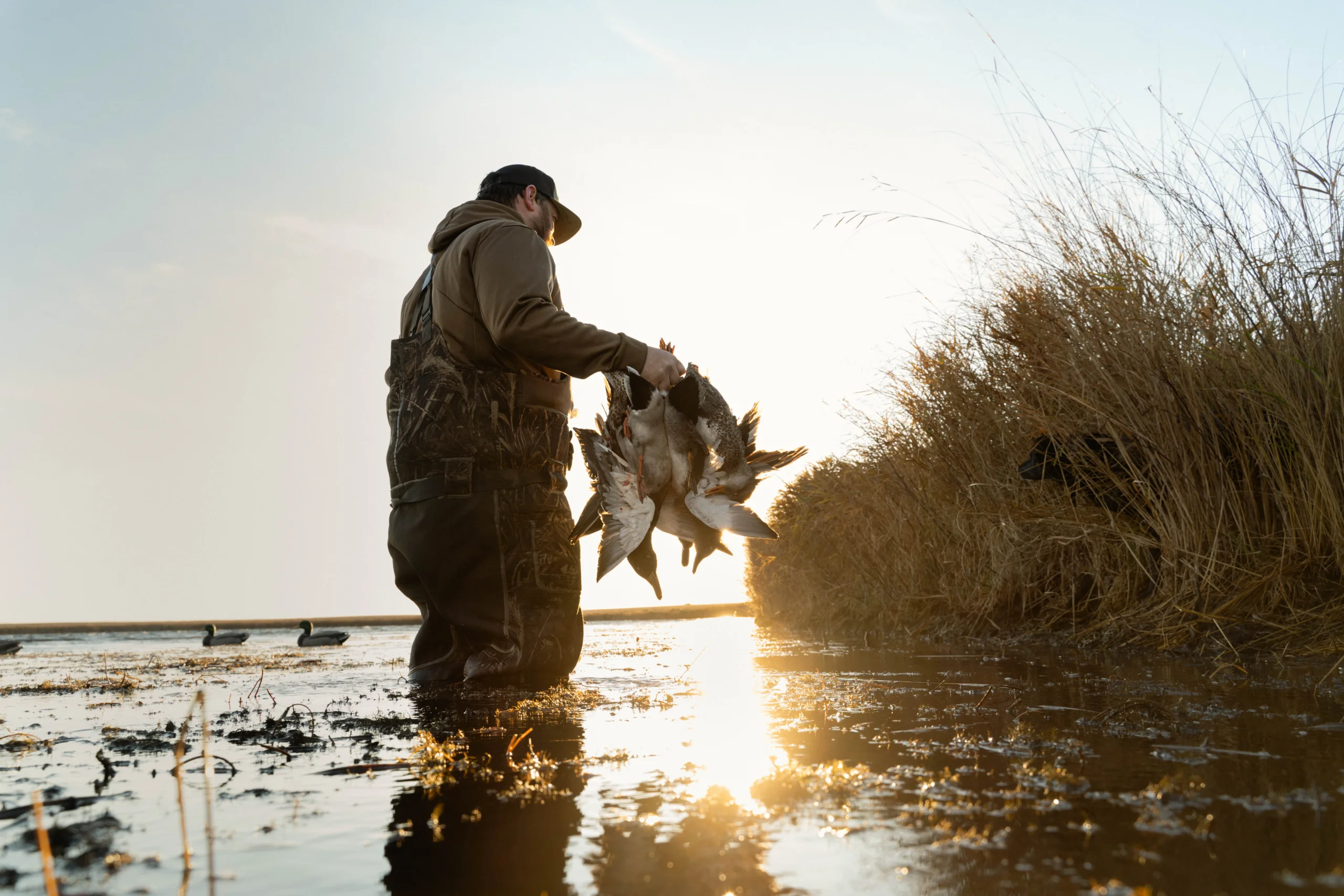
Early Goose Season: How to Hunt September Geese and the Molt Migration
Early Goose Season: How to Hunt September Geese and the Molt Migration
Migrators.
Sky-high lines of giant Canada geese riding a north wind. Some Septembers in Minnesota feel like summer hanging on with 80-degree afternoons, others feel like fall showing up early with 50-degree mornings and a bite in the air. But when the birds are moving, none of that really matters—you’re still watching clouds roll in, still reaching for the call, and still trying to pull those geese down over the decoys.
That’s what comes to mind when I think about early goose season in the Upper Midwest.
Opening day always carries its own excitement. For a waterfowl hunter, those dates get circled on the calendar long before the season arrives. But early goose season offers something else—the first real hint that summer is ending and another waterfowl season is about to begin. For Canada goose hunters across the Upper Midwest, it’s the first chance to get back into the field.
And if the weather lines up just right, it can bring something even better.
Molt Migrators.
The September Migration
If you’ve never experienced a true September molt migration in the Upper Midwest, you’re missing one of the greatest shows in waterfowl hunting.
For those not familiar with the molt migration, Canada geese—particularly nonbreeders and unsuccessful breeders—can travel considerable distances north to traditional molting areas during the summer. By late summer and early fall, those birds are back on the wing and beginning to move south.
Exactly what you’re seeing when a big September push comes through is harder to know from the blind. Are they returning molt migrants? Birds relocating from northern summer grounds as food sources change? Or are they simply doing what birds do—migrating because it’s time to push and the first real cold front told them to go?
Hunters will probably debate that part forever.
But if you hunt geese long enough in the Upper Midwest, you know the phenomenon.
A strong September cold front arrives. The temperature drops. The wind swings around from the north.
And you start looking at the sky.
Reading the Weather for Early-Season Geese
So how do you know when the molts are going to roll?
The answer is simple.
Weather.
The complicated part is knowing which weather to watch.
I’m looking for the first real punch of fall. A sharp temperature drop is a good start. I want to see strong north winds and a cold front with enough strength behind it to move birds.
But I’m not just checking tomorrow’s forecast where I’m hunting.
I’m looking north.
Way north.
When I see a promising weather pattern developing, I’ll start checking forecasts from Churchill, Manitoba, down through Winnipeg, northwestern and north-central Minnesota, and western Ontario. I’m trying to understand what is happening hundreds of miles north of me and follow that weather as it works its way south.
What I Watch For in the Forecast:
- A meaningful temperature drop
- North winds behind the front
- Cold developing well north of the hunting area
- A front progressing steadily south
And then you wait.
Not every cold front produces migrators, and not every early goose season gives you one of those unforgettable days. That’s part of what makes them special.
But every once in a while, everything lines up.
Molt Migrator Monday
The last truly unforgettable molt migration I experienced in Minnesota happened on September 7, 2020.
I call it Molt Migrator Monday.
Everything lined up.
The week leading into opening weekend, the forecast was screaming that Labor Day could be the day. The pattern held. The cold was coming. The wind was coming.
And everybody knew it.
By Labor Day morning, goose hunters across the Upper Midwest were waiting.
Then things got crazy.
People were killing geese all across the top of the flyway. Snapchat was going wild. Facebook and Instagram were filling up with photos and videos. Text messages were coming nonstop from hunting group to hunting group.
Ask a goose hunter who was out that day what they remember about September 7, 2020, and there’s a good chance you’ll get a grin before they even start talking.
We knew what kind of day it could become, so we planned accordingly.
We set up on a loaf pond with a trailer blind and a big spread of full-body decoys and floaters. It was one of those setups that just looked right.
We even packed breakfast and lunch to cook in the blind.
Because that’s another thing about hunting migrators:
You have to be willing to wait.
You can sit there all morning wondering whether you completely misread the weather. The sky can be empty.
Then at 10:30, you see it.
That first line coming from the north.
And everything changes.
When the Sky Opens Up
Because we were hunting water, we hadn’t broken down much of the spread after the early groups of local birds.
That turned out to be a good decision.
By late morning, the script flipped and the big groups wanted down on the water.
Then it was our turn.
We worked big wads of geese. Smaller groups. Singles that seemed to fall straight out of the clouds.
Some birds would circle and work. Others looked like they had already made their decision before they reached us. They’d dump the air and give it up all the way into the spread.
We even managed to pick up a band from Churchill, Manitoba, that day.
It was one of those hunts where you spend the entire time thinking, This is actually happening.
How to Set an Early-Season Goose Spread
The setup we used that day was big, but I don’t always believe more decoys are better during early goose season.
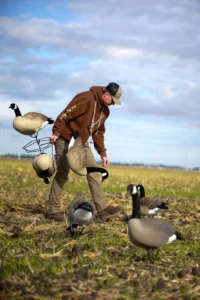
When we’re hunting smaller groups of local birds, I like a natural-looking spread.
I’ll mix Rogue Series Full Body Decoys, Dominator Series Full Body Decoys, and Rogue Series Goose Sleeper Shells, but I don’t pack everything into one tight group. I prefer a loose, wide-open spread with smaller groups scattered throughout—some birds close together and others separated by plenty of space.
In green fields, hay fields and other early-season situations, that can look much more natural than one giant concentration of decoys.
There’s another advantage to spreading things out: it keeps approaching geese from becoming fixated on one specific area of the spread—and potentially one specific area where we’re trying to hide.
On water, I like the same philosophy of keeping things simple and versatile.
I run my Rogue Series Floating Goose Decoys on Texas rigs with longer lines—usually around 72 inches—and heavier 8-ounce weights. That gives me enough line and weight for bigger water or windy conditions without creating problems when we move to smaller water.
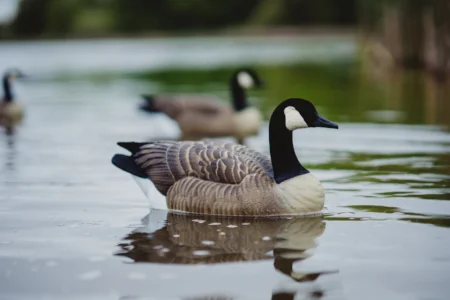
I’d rather have one rig that works almost everywhere than spend my season changing rigs for every hunt.
How to Hide for Early Goose Season
Early-season concealment creates its own challenges.
Everything is still green. Crops and grasses haven’t necessarily reached the same colors and textures we’ll see later in the fall.
And then there’s the dew.
Ask hunters what they enjoy least about setting a blind in September and stuffing wet vegetation into it before sunrise probably won’t be high on the list.
That’s one reason I like using ghillie material early in the season.
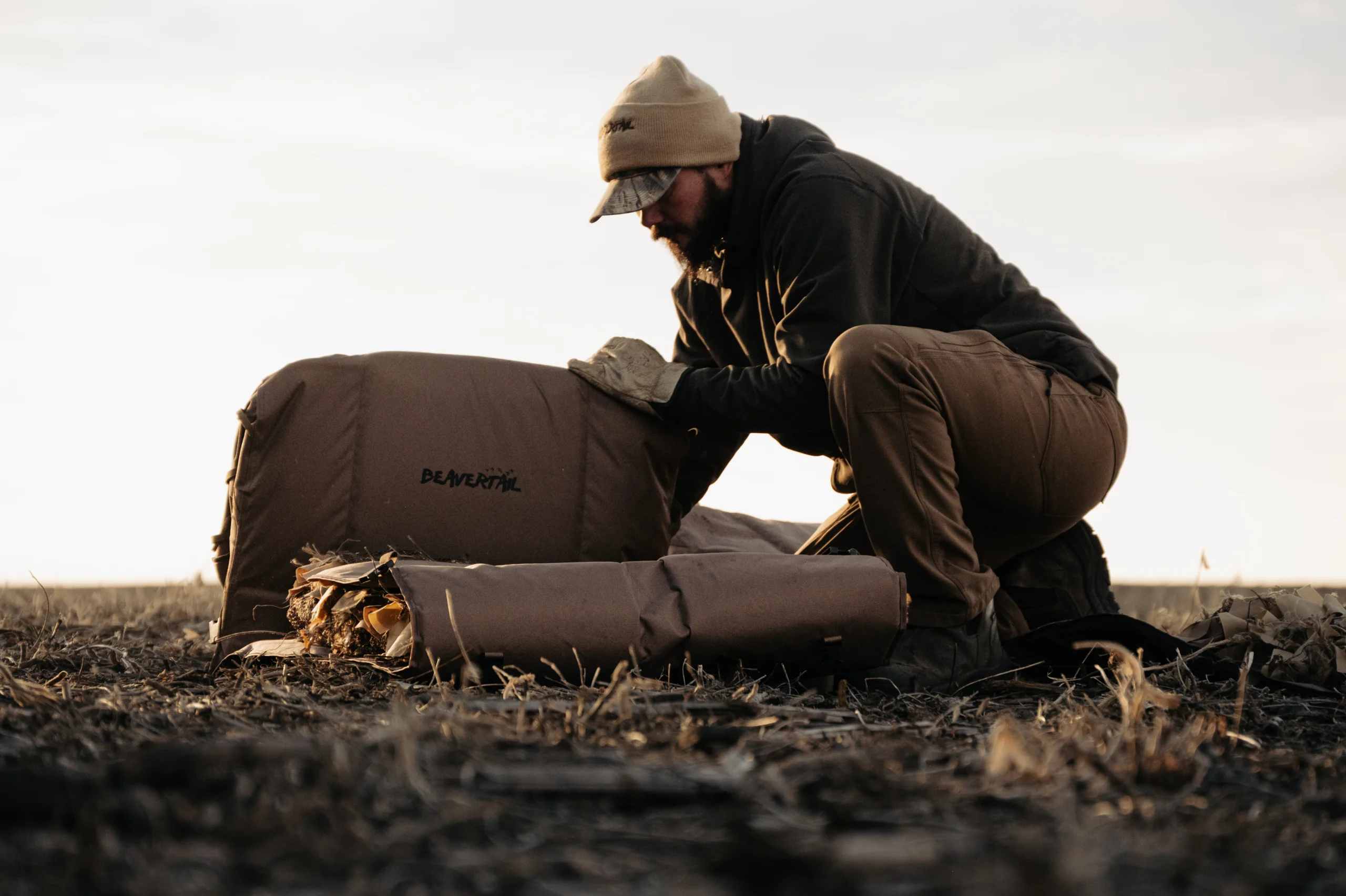
For green vegetation, I like pairing the Rampage Backpack Blind with a Green Field Concealment Blanket. In wheat, hay or lighter-colored fields, the Golden Grain blanket that comes with the Rampage is a natural fit. Either setup gives us a strong starting point while reducing how much natural material we need to add.
The backpack storage in the Rampage is another small detail I appreciate. Calls, extra clothing and other gear can disappear underneath the backrest instead of becoming clutter scattered around the blind.
Early-season geese haven’t seen months of hunting pressure yet.
That doesn’t mean they’re stupid.
A natural spread and a clean hide still matter.
Four Dogs
As memorable as the geese were on Molt Migrator Monday, one of my favorite memories from that hunt wasn’t really about the geese at all.
It was the dogs.
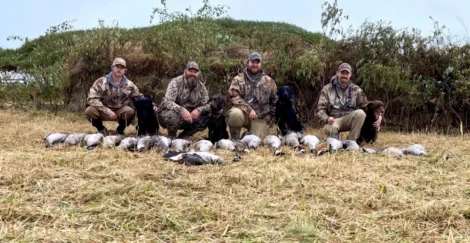
We had four dogs with us that day, which isn’t something we’d normally do. Every dog stayed under control on a check cord, and after each volley we’d take turns sending two dogs.
Watching two well-trained retrievers work together is something every waterfowl hunter should experience at least once.
Watching four dogs work in pairs throughout a day like that was incredible.
Looking back at it now means even more.
One of those dogs is no longer with us.
The other three have become veterans, and one is now 11 years old and heading into what could be her final season—or one of her final seasons.
That’s the thing about opening days.
When you’re younger, they feel endless.
Another September. Another opener. Another season.
But eventually you realize they aren’t endless.
The dogs get older. Hunting partners change. Kids grow up. Places change. And some of the people and dogs that were there for the hunts you’ll talk about forever won’t always be sitting next to you when the next opening day arrives.
Maybe that’s part of why we watch the weather so closely.
Why a north wind in September can make it hard to concentrate on anything else.
Why we remember a single Monday from six years ago like it happened yesterday.
The seasons don’t always begin like September 7, 2020.
But every year, when the calendar turns to September, we know there’s another chance.
Another cold front.
Another line of geese appearing from the north.
Another morning with good buddies and great dogs.
Another beginning.
That’s early goose season in the Upper Midwest.
And I wouldn’t miss it.
In Memory of Mowgli
By Ben Marleau
U.S. Sales Manager | Beavertail Outdoors & DOA Products
Published July 2026
From full-body decoys and floaters to blinds and concealment, build your early-season setup with gear designed by waterfowl hunters.